Showing posts with label setting. Show all posts

Thursday, December 4, 2014

Romance and Mystery Authors on Writing: Author Marsha R. West with Tips on Dialogue, Setting, and Editing, Giveaway


Hello and welcome to this Thursday's writing tips in the Romance and Mystery Authors on Writing series. Mystery author Marsha R. West shares her writing tips on dialogue, settings, and editing. Marsha has brought along an e-book copy of her mystery, Truth Be Told. 


Win the drawing for a copy of Truth Be Told by subscribing to Marsha's blog. Hop over to the Marsha West blog after reading all her great tips here today. 


      Hey Marsha, thanks so much for bringing tips for us today. What are two of your favorite information-packed writing books? 
      
There are many, but two that I have are post noted, highlighted, and dog eared (yes, I have the paperbacks) and are great helps with editing. I’m embarrassed to say a couple of judges from the first contest I entered suggested I get these. They also suggested I get one on Goal Motivation and Conflict. (I really knew nothing about the craft of writing fiction, especially genre fiction.) Here are the first two:
 SELF-EDITING FOR FICTION WRITERS  by Renni Browne & Dave King
THE ELEMENTS OF STYLE by William Strunk, Jr. & E.B. White

Whether you have a publisher who provides an editor for your manuscript or you hire an editor (And you are doing that, right?) because you’re Indie publishing, you will be ahead of the game to send as clean a copy as you can possibly get to your editor.
# # # #
Thanks so much. Now read more of Marsha's writing tips below.


DIALOGUE: Read your work out loud. That’s the best way to see if it sounds natural. Try to have the characters each have specific characteristics to their speech. In one book, I realized everyone said “hell.” I decided to give a certain swear word to each  of the main characters to help differentiate them. Thank goodness for the “Find” button! I fellow writer, actually had a hero who spoke in really short sentences—like 4 to 6 words! It really worked for her and for him. J

SETTINGS: I’m drawn to settings. I may even start with that before I have the characters. Helping the reader get a real “feeling” for the locale of the story is important to me. I had a friend who wrote a thriller set in one of the hottest on record Texas summers. The heat became almost a character in that book affecting everyone’s actions.

   EDITING: I first learned about Throw Away words from Margie Lawson. I tend to be wordy.
(My first book had 145 thousand words before I began cutting, getting it to 100K.) And this was when agents and publishers were looking for 80 to 90 K. No one would look at such a long book. I had a great story, but no craft skills. The idea of eliminating any of my wonderful words made me ill. Time passes and now I write 75-90 K books. Much tighter than when I began. I got there by using a list of 75 words and phrases I (and others) over use. I’ve added to the original list of about 30 words as I’ve discovered my favorites.
Quick look at my favorites: that, some, little, bit, (as in a little bit), even, began to, tried, just, really, thing(s)
Omit these words to help keep you in deep POV: think, thought, thinking, mused, wondered, see, seeing, looking, believe, considering, hearing.
Not: He thought he heard a noise.
Better. The large crash threw him from his bed.

After I’ve finished all the re-writes I go through doing a search and find for the words. I study each use and decide if I can make it better. If it’s unnecessary, I hit delete.
Most of the time, contrary to what you might be thinking, your word count may go up rather than down when you use more specific language than saying “things.”
I’d be happy to send you the complete list. marsha@marsharwest.com Then you can add your own favorites. I’ve noticed with different books, I’ll pick different words to over use, so I add those to my list. That’s how the list has grown.
# # # #
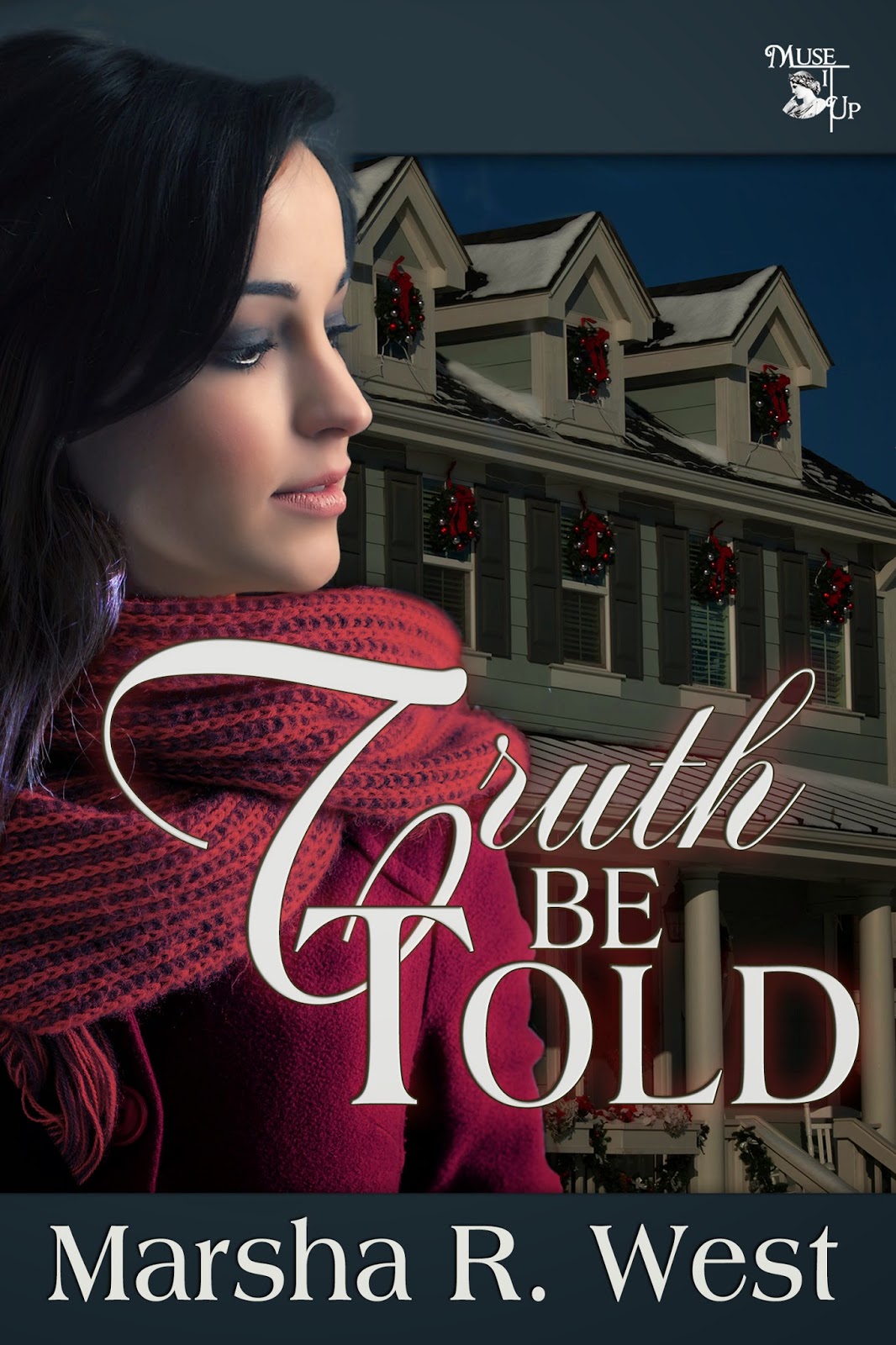
  SWAT member teams with her brother's former homicide detective partner to stop a blackmailer. 
Falling in love wasn't one of their strategies.
 Buy Link for Truth Be Told 


About Marsha:
 Marsha R. West writes Romance, Suspense, and Second Chances. Experience Required. MuseItUp Publishing released her first book, VERMONT ESCAPE in July 2013. Marsha released the print version of the first book in the fall of 2014. Her second book, TRUTH BE TOLD,  was released by MIU in May 2014.  She’ll release her third book, SECOND CHANCES, in February 2015, the first of a 4-part series. Find out more at www.marsharwest.com She’d love to hear from you.


Wednesday, October 29, 2014

Romance and Mystery Authors on Writing with Gail Roughton, Giveaway

Wishing you a happy and safe Halloween!

Speaking of Halloween, today we welcome our author-tipster Gail Roughton who penned an entire series about a witch and a warlock, perfect for this time of year. Witch Resurrected is the first in this fun, action-packed War-n-Wit Inc. romance/mystery. You could win that e-book or take your choice of any PDF format of e-books on Gail's Amazon page just by leaving a comment below.


Welcome, Gail! You've conjured up fantastic tips for us today. I've invited all these folks to pull up a chair to your kitchen table and enjoy a chat in your Southern home. It's fall now so I don't know if you're serving delicious Southern sweet tea or hot apple cider to our visitors. Let's start off with your "light bulb" moment in your writing experience.


I don’t know the exact moment when it clicked but my writing changed from amateur to professional when I learned how to show, not tell.  That’s what every publisher wants, what every editor tells you to do.  Unfortunately, they don’t tell you how to do it.  I don’t think they can tell you, because I think the “click” happens differently for everyone.  The closest I can come to an explanation is an example.  It’s really hot outside. How do you show that and not tell it?  Let’s see.  “It was very hot outside.”  Well, big whoop.  That’s a statement of fact, but it doesn't make the reader feel hot, now does it?  So okay.  “It was hot enough to fry eggs on the sidewalk.”  Better, but a standard cliché and clichés are to be avoided as much as possible.  So try again.  “Steam sizzled up from the sidewalk.”  Do you see those threads of steam streaming up from the concrete?  That’s show.  Not tell.  And it’s like riding a bicycle.  Once you hear that “click”—you can’t un-hear it.  You’ll never write the same way again.

Thanks, Gail, for that excellent advice on show and tell. 

Now, Readers, Gail didn't play any tricks on you. Her tips on dialogue, characters, settings, editing, marketing/promoting are solid treats for writers. Ya'all get comfortable and read on.

DIALOGUE
Dialogue is your best friend. It carries your book. It can turn any novel, however short or however long, into a quick, fast, fabulous read, provided it reads naturally.  People don’t speak in grammatically perfect, complete sentences, and neither should your characters. 
People have their own speech patterns, flow, idioms and idiosyncrasies based on birthplace and background.  So should your characters. Absolutely nothing jars a reader, at least me (me being the reader I know best) out of story faster than a character talking “out of character”.  A good ol’ southern boy is not going to suddenly proclaim, “Oh, my! That startled me out of my wits!” He’s going to say “That ‘bout scared the pants off me!” (Actually, that’s not really what a good ol’ southern boy’s going to say in such a situation but this is a G blog and you get the general idea.)  Also, watch those tags.  In a two-person conversation, it’s pretty obvious which character is talking.  Adding tags after every line of dialogue breaks the flow and thereby defeats the entire purpose of dialogue in the first place.  You want the reader to feel as though they’re listening to a conversation, not reading one. 

CHARACTERS
I know writers who develop their characters like a science project.  They make lists of physical attributes, traits, activities.  They even chart their horoscopes.  And it works for them, so more power to them.  I don’t know where my characters come from.  They just – appear.  Sometimes fully grown and raring to go, sometimes in a ghostly shadow that gradually acquires solid form and substance.  I start writing when they stand up independently and start walking and talking and telling me their story.  They tell the story, not me.  I just transcribe their words and actions onto a computer screen.  I can’t tell you how to develop a character because I don’t know how.  And once the story’s told and the book’s written, I look at both the characters and the book itself the same way I look at my children – with an intense feeling of disbelief that I created them, that I had anything to do with them.  They’ve become independent entities I really had very little to do with.


SETTINGS
Write what you know.  Write where you know.  Someplace you’ve at least visited, even if you haven’t lived there.  Now sometimes, of course, characters suddenly decide they’re taking a vacation to someplace you know nothing about.  There’s this wonderful thing called the internet , usually full of videos of that exact place, lists of attractions, restaurants, you name it.  But to write a book where a reader can live, stick as much as possible with what you know, where you were raised, someplace you love.  Or hate. Depends on the mood you want to convey, of course.  Also, remember it’s not necessary to fully describe every tree in the woods, every bush in a yard.  Description sets a mood and a scene. Every reader will envision the details in their own unique way, personalize the story so it resonates with them.  You’re telling a story.  You’re not writing a travel guide. 

1      EDITING
When you first finish a book, put it aside for a while. At least a week, preferably a month to six weeks.  Then re-read it.  You’re your own best first editor.  Then take a scalpel to it.  With the ruthlessness of a surgeon.  Nothing you wrote is so good it can’t be improved.  Nothing you ever write is so good it can’t be improved.  Read it like you’re reading it for the first time, like you just picked it up in a bookstore.  And be honest.  If you’d just bought this book, would you keep reading it?  If not, why not?  That’s for the story itself.  Insofar as the technical writing, how many unnecessary words can be cut?  I’m speaking specifically of the dreaded “that”, as in  “Mary knew that she was in trouble.  Sarah knew that she was in trouble, too.”  Oh, yeah, those “that’s” repeated over and over really slow a reader down.  “Mary knew she was in trouble. Sarah knew it, too.”  Then move on to the second editor.  Somebody that’s not you.  They’re going to see a lot of things you missed completely.  Typos, incongruities in the timeline, missing gaps of necessary information, information dumps that are completely unnecessary.  And sometimes—gasp—they’re actually going to suggest an alternate way of phrasing a passage or structuring the plot.  And here’s where a serious writer needs to lose that gasp of outraged indignation and lose it quick.  LISTEN TO THEM.  They might be wrong.  But they might be right.  Don’t get your feelings hurt.  Because one more time—nothing you wrote is so good it can’t be improved.  Nothing you ever write is so good it can’t be improved.

1    MARKETING/PROMOTING
Write a good book. All the marketing and promoting in the world won’t sell a book that’s boring, poorly edited, full of errors, and populated by cardboard characters. The best promo is the next book.  And that next book better be just as good as, if not better, than the first.
# # # #

ABOUT GAIL ROUGHTON
Gail Roughton is a native of small town Georgia whose Deep South heritage features prominently in much of her work. She’s worked in a law office for close to forty years, during which time she’s raised three children and quite a few attorneys. She’s kept herself more or less sane by writing novels and tossing the completed manuscripts into her closet.
Gail and Grandson
A cross-genre writer, she’s produced books ranging from humor to romance to thriller to horror and is never quite sure herself what to expect when she sits down at the keyboard. Now multi-published by Books We Love, Ltd., her credits include the War-N-Wit, Inc.  series,
War-N-Wit, Inc. - Witch Resurrected, War-N-With, Inc. - Mean Streets, The Color of Seven ,Vanished, and Country Justice. Currently, she’s working on Black Turkey Walk, the second in the Country Justice series, as well as the Sisters of Prophecy series, co-written with fellow Books We Love, Ltd. author Jude Pittman. Another War-N-Wit plot always seems to be brewing on the back burner, too, whether she’s actually trying to brew one or not, and usually boils quicker when she’s trying not to brew one at all.  Stop in and visit! You can reach Gail at:   http://gailroughton.blogspot.comhttp://flowersonthefence.blogspot.com or message her at www.facebook.com/GailRoughton

Do you have questions for Gail about writing? Please ask or just say hi to be eligible to win the drawing for you choice of e-book on the Amazon page. 

New Beginnings with J.Q. Rose

Happy New Year from J.Q. Rose! Photo by  Carson Arias  on  Unsplash   Hello Friends, Welcome to Focus on Story! Happy 2026! January 1, 2026,...

Popular Posts from Last Year