Showing posts with label writing memoirs. Show all posts

Tuesday, August 20, 2019

Author Toolbox Blog Hop: Books are Tools Too

#AuthorToolboxBlogHop
Hello and welcome to the Focused on Story Blog and to the Author Toolbox Blog Hop #AuthorToolboxBlogHop which meets every third Wednesday of the month to share resources and tips for authors. Thanks to Raimey Gallant for hosting this venture. 

Please join us to learn more about the craft of writing and to meet bloggers who are dedicated to helping each other become the best writers possible. Click here for the list of participants and take a break and visit them. 
🛠🛠🛠🛠
Books are Tools Too

I don't usually think of books as tools. However, every tool comes with a page or pamphlet or book of instructions. So I believe books on writing are definitely tools to instruct us on the art of constructing our stories as well to help us learn how to publish and market them.

Today I'm sharing books I've used to learn about writing and writing life stories and memoirs. 

At this time, I'm working on creating a journal for those who wish to learn how to tell their life stories and a memoir which covers the first year we were in the floral business. (I wish I'd had a book of instructions for that giant leap.)

"Our lives are filled with extraordinarily ordinary moments. 
Our souls are illuminated by them.  
Sharing them around the hearths of our hearts, 
we become tellers of sacred tales, artists of our lives."
                                                         ----Dr. Susan Wittig Alberta, Writing from Life


Below is my review of one of the books on the list. I recommend it for writers even if you are not writing a memoir!

BOOK REVIEW: Writing Life Stories by Bill Roorbach
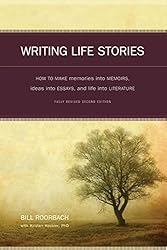
Writing Life Stories: How To Make Memories Into Memoirs, Ideas Into Essays And Life Into Literature
Writing Life Stories by Bill Roorbach
Writing Life Stories: How to Make Memories into Memoirs, Ideas into Essays, and Life into Literature by Bill Roorbach is eye-opening, thought-provoking, and full of wisdom for burgeoning writers, as well as experienced authors. His literary grade language and insight into what writing really is made me appreciate my choice to become a writer. This book is an inspiring read.

Bill, if I may call him that, brings clarity to the memoir genre. Incorporating rules of fiction writing with non-fiction events is an art. I soaked up every bit of the information he shared. He's a teacher as well as a writer and allows us to explore this marvelous genre through writing our own articles as exercises at the end of the chapter. I wish I were actually sitting in his classroom so I could be in a lively discussion with him and students on all the topics he covers.

My vocabulary grew because of his expertise in the English language. I discovered words like "adumbration" and "enjambment." 

These are quotes by Bill I want to keep in mind such as:

In regards to the writer's voice--"Emotion is the sound of a writer's voice."
In regards to writing--"This is art we're talking about, not a job."

I don't usually do book reviews, but this is more of a love letter to this book. If you are looking for a book on memoir-writing, pick this one up. I actually borrowed the kindle edition through amazon Prime's program. You know it had to be worth reading because I broke down and actually bought the paperback book!


If you have any comments about a book or wish to add to the list, please leave a comment below.

HELPFUL BOOKS ON WRITING
Albert, Susan Wittig.  Writing from Life:  Telling Your Soul’s Story
Baldwin, Christina.  Life’s Companion:  Journal Writing as a Spiritual Quest
Corey, Judy. Storysharing:  A Bridge Between Generations
Daniel, Lois.  How to Write Your Own Life Story
Goldberg, Natalie. Writing Down the Bones: Freeing the Writer Within
Hauser, Susan Carol. You Can Write a Memoir
Heilbrun, Carolyn.  Writing a Woman’s Life
King, Stephen. On Writing
Roorbach, Bill. Writing Life Stories
Strunk, William and E.B.White.  The Elements of Style
Zinsser, William.  Inventing the Truth:  the Art and Craft of Memoir


Thursday, July 24, 2014

Series: How to Begin Recording Your Life Story Part 5, Summary and Bibliography


Welcome to the fifth and final blog post on How to Begin Recording Your Life Story by J.Q. Rose. Today I want to summarize the salient points in this presentation to remind you of how important your life story is. Your experiences should be shared whether they are light-hearted, serious, instructive, or just down-right delightful reading. Click on part to link you back to the complete blog post on that subject.

At the end of this post, I included a Bibliography of books I think that will help you and inspire you to write your story. Readers are writers and these examples are great reading. Please suggest a book on writing or a memoir to add to the list. I'm always looking for new books to share with friends and family, and especially life story writers!

A Summary of the How to Begin Recording Your Life Story Series


Part 1 What is memoir/life story, why record it, spark your memories
~A memoir or life story fleshes out your story revealing your memories, but also emotions
Don't try to tell it all from the very beginning. Write in vignettes or snapshots of your life. 
A memoir can be recorded by writing your life story or by telling your story using an audio file e.g. mP3 or video format.

~A memoir can be recorded by writing your life story or by telling your story using an audio file e.g. mP3 or video format.
Can you guess
what car sported these tail lights?
Image courtesy of Matt Banks
 FreeDigitalPhotos.net
~Your memoir can comfort and assure someone else knowing how you faced and defeated problems in your life, demonstrated grace in situations, and found joy in living an ordinary life.
~Seeing your life through the lens of time, people’s actions, emotions, and words become more clear to you than when you actually lived the moments.
~You will preserve the family history as well as telling the “real” story of historical events and how they affected your ordinary life.
~You will discover revisiting your life is a lot of fun!
~To help you spark memories and track notes on stories you remember, make a Memory Bank.
~Spark your memory by using a time line, life stages, photos, and writing prompts.

Part 2 Opening up your memories and organizing your story
~Use free writing to open up your memories.
~After writing several stories, organize them using themes you will discover in those stories, arrange in chronological order, or relate your present life to past experiences.
Vintage Typewriter
Image courtesy of koratmember
FreeDigitalPhotos.net
~Always include the five w’s in your writing-- who, what, where, when, why, and how.
~Show, don’t tell your stories.
~Use the five senses and your feelings to add interest and to draw the reader into the scene..

Part 3 Editing and publishing
~After writing your story, go back and make it better by tightening up the story and checking for grammar and spelling errors.
~When writing a memoir/life story, the writer must tell the truth at all times. For if the truth is not told, what is the point in writing the story?
~If you decide to publish your memoir, I listed some places for you to submit. Find more by searching online or by visiting your library.

Part 4 Using writing, audio, and video to record your story 
~There’s more than one way to record your story. Writing, making a video, recording an audio file are all ways to tell your story. Choose one or try all of them to see what fits you.

Thanks so much for visiting. Has this series inspired you to begin recording your story? I hope you will take a few ideas with you so some day you will sit down to record your life to share with others.

I am always ready to help you get started. Email me with questions at jqrose02 at gmail dot com or leave a comment below.
# # # # 

WRITING YOUR LIFE STORY--BIBLIOGRAPHY

HELPFUL BOOKS ON WRITING
Albert, Susan Wittig.  Writing from Life:  Telling Your Soul’s Story
Baldwin, Christina.  Life’s Companion:  Journal Writing as a Spiritual Quest
Corey, Judy. Storysharing:  A Bridge Between Generations
Daniel, Lois.  How to Write Your Own Life Story
Goldberg, Natalie. Writing Down the Bones: Freeing the Writer Within
Heilbrun, Carolyn.  Writing a Woman’s Life
Strunk, William and E.B.White.  The Elements of Style
Zinsser, William.  Inventing the Truth:  the Art and Craft of Memoir

JOURNALING
Sarton, May.  Journal of a Solitude

MEMOIRS/LIFE STORIES
Baker, Russell. Growing Up
Bush, Barbara.  Barbara Bush:  A Memoir
Buck, Frank All in a Lifetime
Chaplin, Charles. My Autobiography
Dillard, Annie.  An American Childhood
Downing, Christine.  Journeying through Menopause
Frank, Anne.  The Diary of a Young Girl
Gilbert, Elizabeth. eat, pray, love
Goldberg, Natalie.  Long Quiet Highway: Waking Up in America
Gordon, Ruth. Myself Among Others
Grogan, John.  Marley and Me
Hayes, Helen. On Reflection
Keller, Helen. Story of My Life
King, Coretta Scott.  My Life with Martin Luther King, Jr.
Marshall, Catherine. Beyond Ourselves
Moses, Anna Mary. Grandma Moses, My Life’s Story
Norris, Kathleen. Family Gathering
O’Reilly, Bill. A Bold Fresh Piece of Humanity
Roosevelt, Eleanor. On My Own
TenBoom, Corey.  The Hiding Place
Weisel, Elie.  Night


Thursday, July 17, 2014

Series: How to Begin Recording Your Life Story, Part 4: Using Writing, Video, and Audio


“Too many people overvalue what they are not, and undervalue what they are.”
                                                                                                             --Malcom S. Forbes
Welcome to Part 4 in the series, How to Begin Recording Your Life Story. After last week's post my friend and fellow author, Helena Fairfax, left this comment--

Hi JQ,
I subscribe to a British magazine for women writers called Mslexia. You might be interested to know they're holding free workshops to help you write your own memoirs They also have a competition on at the moment for memoir writers. I thought it would be of interest. 

Thank you, Helena, for introducing this magazine for women writers to the readers and me and for the heads-up on the memoir writing workshop.  The post on writing memoirs was very informative and made good points for memoirists to keep in mind as they begin their writing. Lots of inspiring blog posts and writerly information to be found here.

I love being connected on the Internet where readers and writers help each other just like this.
# # # #
Using a headset
Image courtesy of Ambro / FreeDigitalPhotos.net

The title of this series is How to Begin Recording Your Life Story. Recorded is intentionally used in the title because there are many ways to tell your story and keep it as a record for your family and friends. Usually we talk about writing, and I must admit, I am more inclined to give folks tips on writing out their life experiences because I am a writer. 

Instead of blocking your path by insisting on writing, I want you to be aware there are other ways to share your stories. And I must point out that you are the only one who can tell your story. You are the keeper of your life story. You are the only one who can tell the truth about your life choices or not having choices and the experiences that colored your life. 

You may want to have a writer interview you and let her put together your story on paper for you or record your accounts on video or audio.

Dealing with the technology may be too difficult for you and overwhelming. If you wish to do it  yourself, ask someone in your life like the kids, yeah those young whipper-snappers, who know all about the programs available. 

Deciding to take the DIY approach, I've been exploring methods to accomplish this. There definitely is a learning curve on all this technology, so if you want to try learning about making a video or audio file, Youtube is your best friend. You can find out about everything on Youtube!! Your next place to discover how-to information is to "google" the information. Go to google.com or your favorite search engine. In the search bar, place "audio file" or "make a movie" or similar key search words. Don't use the quotation marks around your search words.

I have listed the places I explored:
  • Windows Live Movie Maker--to find out if you have this program, click the colorful round circle (start button) at the bottom left side of your computer screen. Then type in movie maker and it will come up. Click on it, but when you see the screen don't run. Just hop over to Youtube and learn how to use it!! I would love to see a video filled with old photos of your family. Perhaps you have a photo of your grandmother you could use, her house, her wedding photo, add some photos from freedigitalphotos.net of things she was interested in like horses, sewing, playing the piano, etc. You can type your story on each slide and select free music from Kevin McLeod's infotech.com to play in the background. You may prefer to record an audio to accompany each slide. Remember to talk about your grandmother, how she is related to you, share some anecdotes about her, and your feelings about her. Then you can upload the finished movie to Youtube to share with everyone or just family members.
  • Microsoft Power Point--I am ashamed to admit I don't know how to use Power Point very well. This program uses slides and audio can be added to them to make a wonderful presentation. I vow to learn more about it. I'll post it on my blog once I get a decent video made.
  • Video camera--You can have someone video you or set up the video camera so you can talk about your family. You could make a dish your mother was famous for preparing for a family dinner or teach viewers how to crochet a favorite item she used to give as gifts. And again, don't get caught up in the activity only, talk about your mother, your feelings about her, and your relationship to her.
  • Audacity.com--is a powerful program to record audio files. I played around with this to make an audio file which can be exported as an mp3 file and used as a podcast. I really, really wanted to have the file here on my blog to share with you, but, even after googling and watching Youtube videos on how to embed the file into Blogger accounts, I wasn't successful.

I was able to add it to my J.Q. Rose author website. If you recall, I suggested in an earlier post to write a letter to your ten year old self, so I recorded my letter to Janet Lee at Ten. If you're curious and wish to listen to it, scroll down the page and you will see the player right next to the badge for How to Begin Recording Your Life Story. 

Big thank you to my daughter, Lee Ann, for helping me figure out the microphone and answering a lot of questions about the program. (She did voice overs and was a DJ so she had experience with microphones and making audio files.) Let me know if the player worked for you and if volume and clarity are good too. Watch out! If you like the recording, there may be more along the way!!Next week, we'll wrap up the series. I would appreciate any suggestions you might have for adding more information or clearing up any questions about life story writing. Thanks so much for stopping in.

“You must have control of the authorship of your own destiny. The pen that writes your life story must be held in your own hand.” ---Irene C. Kassorla


Thursday, July 10, 2014

How to Begin Recording Your Life Story Part 3: Tips on Editing and Publishing, Prizes


Sharing Your Stories

When most of us write, we want to convey more than the details of our lives. 
We want to convey the meaning of our lives and the lives of those around us
.---Susan Carol Hauser, You Can Write a Memoir

EDITING, REVISING, REVISITING


Let’s fast forward to the time when you have completed your first draft of your memoir. If you are recording it as  an audio or video file, this is the time to check for clear sound and well-lighted video. If you used slides for your presentation, be sure they are in sync with your narration.

Whether writing or recording your life story, you will need to check the following:
Is each story as clear and as well organized as you can possibly make it? Do you have the facts, the descriptions, etc., in the right order for clarity?
 Do you have “over-used words”?  Use Roget's Thesaurus of the English Language or a thesaurus online to help you find different words to use.  
 Do your stories need cutting?  Eliminate wordy paragraphs by not repeating the information over and over and over and over…..
Write/speak in the active not passive voice.
Have you clearly identified every relative you mention?
Have you told enough about your characters for your readers to be able to see and understand them?  Use clear descriptions of the characters and scenes. Include small details    
Did you SHOW rather than tell your story?
For Written pages check to be sure:
All paragraphs should deal with the main idea.
Are sentences complete?  Are transitions smooth?  Do pronouns agree?
Did you check your spelling? Even a spell checker will okay “to” because it is spelled correctly, but you may mean “too” in the sentence.  How about their and there or hear and here?  Use your dictionary or a dictionary online to check spelling.
Did you check punctuation?  Don’t overuse exclamation marks!!!  Did you remember to use question marks at the end of a question?  And use commas sparingly. Check out Jodie Renner's blog post on the Kill Zone blog for punctuating dialogue.

Find someone you trust to read over the story and check all of the above.
--adapted from How to Write Your Own Life Story by Lois Daniel


I must caution you to remember this will be read now and in the future (perhaps e-books or some other device not even created yet). People not even born yet will be reading your story. You want to present the best story you can so that means revising, editing, and revisiting the story several times to polish it.

I realize these stories are very personal. Some of you may not be ready to reveal all your life experiences, let alone share, some of the painful stories in your life. Then do not write them. When you feel you can handle letting go of the story, then do it. Don’t feel you HAVE to write everything.

Above all, I believe when writing a memoir/life story, the writer must tell the truth at all times. For if the truth is not told, what is the point in writing the story? So, don't write it till the truth can be told throughout the entire story. Then when you are ready, let it go, and discover the story from your own perspective at this time rather than when the experience occurred. 
# # # #
Exercise: Write a letter to your ten-year-old self. What advice would you give her now after getting years of life experience under your belt? Do you understand now why people in your life acted the way they did? Do you know why you didn't get to go on the vacation your parents promised? Explore your feelings and don't just give the facts of where you lived and what your favorite songs were.

Publishing
If you decide to publish your memoir, I have listed some places for you to submit. Things change quickly in the publishing business, so google “memoir publishers” or “life story publishers” to keep up-to-date.


Six-Word Memoirs http://www.sixwordmemoirs.com/

Bookmaking—Blurb Books  http://www.blurb.com/
                        Bookemon http://www.bookemon.com/

·         Memoir Writing Sites

Homework:
Write a memoir using only six words. This is a challenging, but fun, exercise for you. Click on the link to give you some ideas. 
When it’s polished, submit to the magazine. Feel free to share it in the comments section below. I'll send you a prize if you do!!

Thanks for stopping in.  If you have questions, please ask.


Thursday, June 12, 2014

How to Begin to Record Your Life Story

Our lives are filled with extraordinarily ordinary moments. 
Our souls are illuminated by them.  
Sharing them around the hearths of our hearts, 
we become tellers of sacred tales, artists of our lives.   
                                             –Dr. Susan Wittig Albert, Writing from Life

Image courtesy of thawats / FreeDigitalPhotos.net
It’s a Gift by J.Q. Rose
The most precious gift you can give to your children is a record of the stories about your family and your life.
Whether you decide to write them in a notebook or computer or record them on video or mP3 file, it makes no difference.  The important thing is that you preserve these stories for future generations. 
Some of you will push back from the idea of telling your life story because you haven't discovered a cure for cancer or designed a space ship to land on Mars. Your life is more important than any of that because you will be a historian writing about your times and happenings of the day. Only you can tell the truth about your life and experiences.
 Future readers will wonder as they peruse the stories how you ever lived without a TV, computer, smart phone, or microwave (or what else they may be using in the future?).  But the story of your life, the struggles, the joys, the accomplishments, will be what they understand.  Your account will be a guide to help them through their own lives.


Decide to Do It Now
Don’t put it off anymore.  Begin today.  Pick one story out of all the family stories and write it down.  Perhaps you remember a funny experience when you were in school.  How about that disastrous Christmas dinner you prepared for your in-laws?  What was your favorite toy when you were growing up and why?  Is there a family recipe that has been passed down from one generation to the next?  Share it and tell about the Grandma or Aunt or the person who used to prepare it for you.

See?  Just pick out one story your family always tells at get-togethers and develop it.  Scribble it down quickly without regard to your Sixth Grade teacher who would definitely mark it up with her red pen. You get the basics of the story (what I call the bones) down on paper, and then you can always go back and flesh out the details.  Don’t worry about grammar and punctuation until you have the story down.  Then you can revise and edit or have some fresh eyes read the story to find errors.

Once you begin writing and discussing your story, the joy you and your family receive from sharing it around your "hearths" or campfires will amaze you.  Have fun with it.
My Mission
As you can tell, I am a crusader for life story writing. I have presented several workshops on Writing Life Stories. In April the woman who influenced me to pick up this cause passed away. To honor her work, I want to continue her mission of encouraging everyday people to record their stories. I will be presenting some ideas to you in the next few weeks to help you get started on writing your story. Please return Thursday, June 19, and the following Thursdays to get motivated to write/record your story. 


Thursday, June 9, 2011

Muse Blog Conference--My Turn Today to Present Writing Memoirs

Amazing information for writers on the Muse Blog Conference. It's on all month AND the workshops will be up forever for you to revisit for inspiration and information. Plus it's FREE!!

Today is my turn to present a workshop on Writing Memoirs. I believe encouraging people to write their life stories is my mission in life. These stories are a precious gift to family and friends and to the future generations. Check out the workshop to find out how to start and ideas for where to publish your story.

New Beginnings with J.Q. Rose

Happy New Year from J.Q. Rose! Photo by  Carson Arias  on  Unsplash   Hello Friends, Welcome to Focus on Story! Happy 2026! January 1, 2026,...

Popular Posts from Last Year